
Start with the myth many US traders repeat: OKX is either a single-purpose trading venue or an opaque platform you shouldn’t touch unless you’re reckless. That binary is misleading. OKX runs a hybrid of centralized exchange services and Web3 tooling; understanding how those pieces connect — and where the security and regulatory boundaries lie — matters more than a blanket judgement.
This article unpacks how OKX’s architecture actually works, what that means for logging in and managing assets from the US, and which trade-offs you accept when you choose centralized convenience versus self-custody. I’ll correct common misconceptions, highlight operational limits, and give clear, actionable heuristics for safer login and asset decisions.
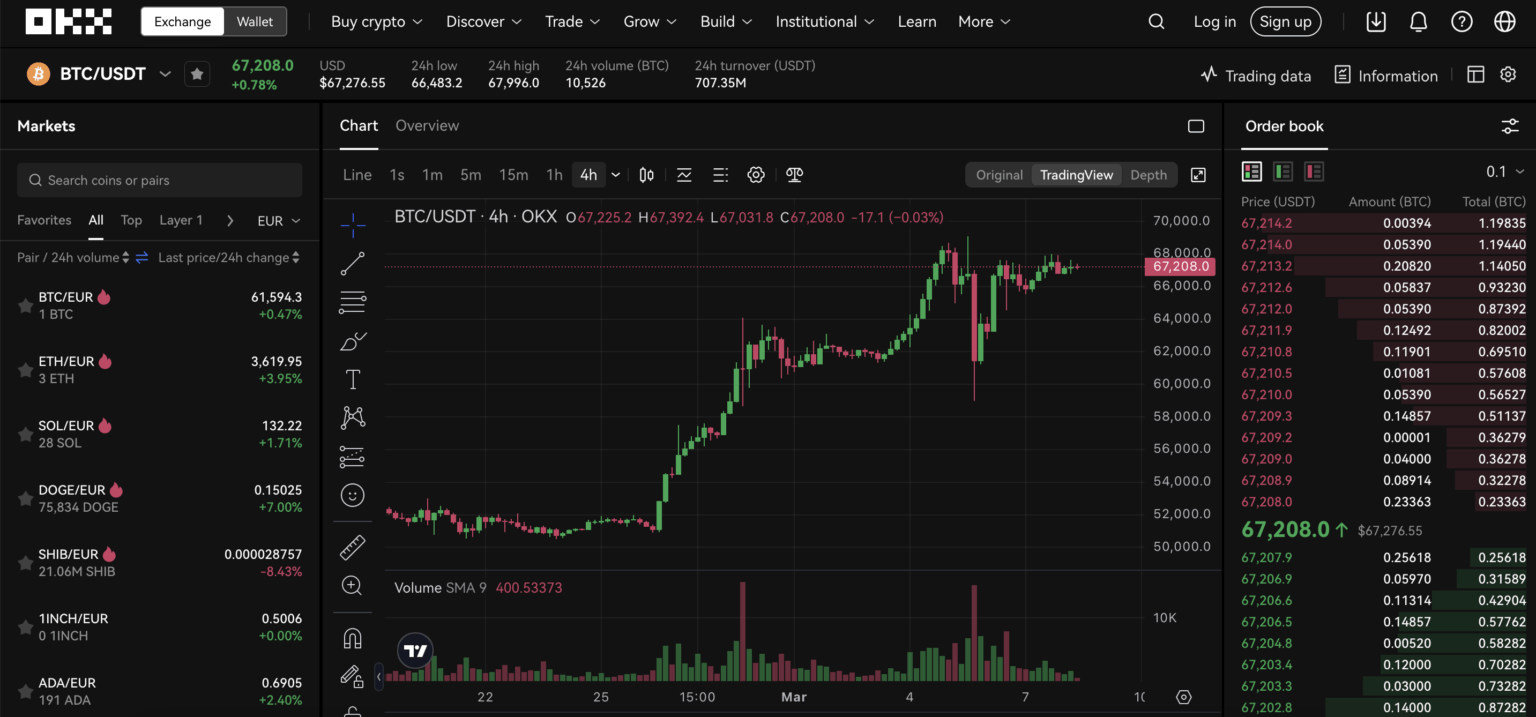
How OKX Actually Combines CEX and Web3 Wallet Mechanics
Misconception: The OKX wallet is the same thing as keeping funds on the exchange. Reality: OKX offers both custodial (on-exchange) accounts and a non-custodial Web3 wallet. Mechanistically, this matters because custodial balances are recorded on OKX’s internal ledgers and covered by their cold-storage practices (over 95% of funds are offline using multi-sig), while the Web3 wallet stores private keys locally under a seed phrase controlled by the user and can integrate with hardware wallets like Ledger or Trezor.
Why it matters for login: when you sign into the OKX exchange you authenticate to a centralized account that requires KYC (ID + liveness check) and mandatory 2FA. When you unlock the OKX Web3 wallet in your browser extension or mobile app, you’re unlocking a private-key store that does not rely on exchange custody. Those are two separate threat models: exchange account compromises trigger internal withdrawal rules and cold-wallet procedures; wallet compromises are often irreversible if a seed phrase is exposed.
Login, Authentication, and What US Traders Need to Know
Common myth: single-factor logins are sufficient if the platform is large. Reality: OKX enforces multiple protections specifically because of regulatory and market exposure. US-based traders should expect KYC as a non-negotiable step to access the exchange side. Login protections include military-grade encryption, AI threat detection for suspicious logins, and mandatory 2FA via SMS, Google Authenticator, or biometrics on mobile. Biometric login in the mobile app is convenient but pairs you with device-level risks (compromised device or backup failures).
Practical login framework: use a dedicated authenticator app (not SMS), separate passwords via a password manager, and enable device biometrics only as a convenience layer on a trusted phone. For the Web3 wallet, prefer hardware wallet integrations for high-value holdings; treat the seed phrase as the ultimate single point of failure — store it offline with geographic redundancy.
Trading Capabilities, Leverage, and Where Things Break
Misconception: High leverage equals free returns. Reality: OKX provides advanced derivatives — options, quarterly futures, perpetual swaps with up to 125x leverage on some assets — and margin up to 10x. Mechanistically, leverage multiplies exposure but also reduces margin buffers and accelerates liquidation risk. The platform’s TradingView charts and order types help, but cannot eliminate slippage, liquidity gaps, or flash volatility.
Trade-off to understand: using leverage improves capital efficiency but converts idiosyncratic execution risks (order queue, spread, slippage) into existential account risks. Always size positions relative to the asset’s liquidity profile and the exchange’s maintenance margin schedule. Delistings (the platform recently delisted several small pairs) change available routes and can make some assets harder to exit quickly; that matters for leveraged positions.
How the DEX Aggregator and Multi-Chain Support Change Risk Calculus
Many users assume the DEX aggregator is a safety net. Not exactly. OKX’s DEX aggregator sources liquidity across major DEXs and supports cross-chain transfers across 130+ blockchains, which can find better swap routes and lower slippage on some trades. But cross-chain bridges and aggregator contracts introduce smart-contract and bridge risk—attacks or bugs in third-party liquidity pools remain outside OKX’s custodial protections when you operate from the Web3 wallet.
Operational implication: if you swap within the exchange (CEX), you’re within their custody model and benefits like PoR (Proof of Reserves) apply. If you bridge or swap via the Web3 wallet into DeFi, you shoulder smart-contract and front-end phishing risks. For US traders who value regulatory clarity, keeping large operational balances on the exchange and moving smaller, actively-used amounts to the Web3 wallet for DeFi is often a sensible split.
Myth-Busting: Security Guarantees vs Practical Limits
Myth: Proof of Reserves means absolute safety. Reality: PoR increases transparency — users can verify 1:1 backing on-chain — but it does not immunize against operational errors, fraud in off-chain processes, or systemic market contagion. Similarly, cold storage and multi-signature reduce hot-wallet theft, but do not protect against social-engineering attacks targeting user logins, or the permanent loss when a user mismanages a seed phrase.
Decision heuristic: treat PoR and cold storage as mitigations, not guarantees. Use PoR to check exchange solvency signals, but pair that with prudent exposure limits, withdrawal checks, and a personal contingency plan for seed phrase recovery or hardware failure.
Near-Term Signals and What US Traders Should Watch
Signal-based watching is practical: monitor delisting announcements (as happened this week for several low-volume pairs) because they signal liquidity pruning and can affect exit options for niche tokens. Watch regulatory signals around KYC/AML enforcement in the US: tighter standards change onboarding friction and may restrict certain products. Also track smart-contract audits and bridge security incidents: they inform whether to route swaps through DeFi or stay within the exchange.
Conditional scenario: if regulatory pressure increases for derivatives in the US, exchanges might impose product access restrictions for US accounts — making self-custody plus vetted DeFi strategies relatively more important for advanced traders. That’s plausible given global policy trends, but not certain; watch both legal and product announcements.
FAQ
Q: Is logging into OKX from the US different than elsewhere?
A: The mechanics are the same (username/password + 2FA) but US users should expect stricter KYC and possible product restrictions. Use an authenticator app, verify device security, and keep exchange and Web3 wallet access methods distinct.
Q: Should I keep everything on OKX for convenience?
A: Convenience is real, but so is concentration risk. A practical split is to keep trading capital and settled positions on the exchange and use a self-custodial Web3 wallet (with hardware integration) for long-term holdings and DeFi interactions. That balances custody benefits against self-sovereignty.
Q: Does Proof of Reserves make OKX entirely safe?
A: PoR improves transparency but is not a panacea. It verifies on-chain backing at snapshots and reduces certain insolvency risks, yet it cannot prevent phishing, private-key theft, or off-chain operational failures.
Q: How do I use the OKX Web3 wallet securely?
A: Use hardware wallets for significant balances, keep your seed phrase offline in secure storage, avoid copying private keys into online forms, and confirm domain validity when connecting to DApps. Treat browser extensions as potential attack vectors — keep them limited and audited.
Bottom line: OKX is neither a monolith nor an obvious hazard—it’s a layered platform that gives traders powerful tools but also forces choices about custody, leverage, and cross-chain interactions. For US-based traders, the smartest login strategy is conservative: strong 2FA, separate custody channels (exchange vs wallet), hardware keys for large amounts, and routine monitoring of delistings and regulatory signals. If you want the exchange login page and practical entry steps, start here: okx.
One sharper mental model to keep: think in three compartments — exchange ledger (custodial), self-custodial wallet (private-key), and DeFi contracts (smart-contract risk). Your security posture is defined by how you move value among those compartments, not by whether a platform has a glossy UI. That distinction separates hopeful users from resilient traders.